ALBA Research
The Song of the Stone
Finite element modelling applied to ancient constructions that shouldn't exist.
Four caves. Two hills. One frequency.
Someone carved four cavities into solid granite, spread across two hills 1.6 km apart, with different dimensions, and they all resonate at exactly the same note: 34.4 Hz, within ±0.1 Hz. Measured in 2020 by acoustician Frédéric Chevalier with calibrated instruments.
The caves of Barabar (Bihar, India, ~3rd century BCE) are among the most precisely finished ancient structures on Earth. Sixty square metres of granite polished to optical quality (you can see your reflection) inside a cave with no natural light. Sub-centimetre bilateral symmetry over 10 metres of length. Circular vaults with radii reproducible to a millimetre.
Key fact
34.4 Hz ±0.1 Hz. The probability of four randomly carved caves resonating at the same frequency is approximately 1 in 100,000.
Not just Barabar.
Barabar is not alone. The Serapeum at Saqqara: twenty-four 70-tonne granite boxes with tolerances that challenge modern engineers. Persepolis: ogival vault profiles emerging without apparent planning. Hal Saflieni in Malta: the only prehistoric underground temple in the world. Kailasa, Longyou, Petra: precision in hard stone, at scales that don't match the available tools.
Two observations.
Two things kept nagging. First: the geometries are too precise and too symmetric to have been calculated by hand. These don't look like the output of a planning process. They look like the output of a physical process. Second: the shapes (smooth curved surfaces, walls tapering inward, transitions between flat and curved at predictable heights) are exactly what you get from acoustic erosion.
These questions remain open.
What if the geometry wasn't designed?
What if it emerged from physics?
We put together a finite element simulation. Elastic solver, 200 × 200 grid at 5 cm resolution. Standard granite parameters (E = 65 GPa, density = 2,720 kg/m³). One free parameter: the excitation frequency. One stopping criterion: halt erosion when the cavity resonates at 34.4 Hz. No geometric template. No target shape. Just physics.
Model parameters
The simulation uses standard material properties from the literature. The only tuneable parameter is the flywheel frequency, which sets the excitation. Everything else is fixed.
| Parameter | Value |
|---|---|
| Granite E (Young's modulus) | 65 GPa |
| Poisson ν | 0.27 |
| Density ρ | 2,720 kg/m³ |
| f_flywheel | 110 Hz (14th Schumann harmonic) |
| Bandwidth γ | 35 Hz, 40 modes superposed |
| α_gravity | 0.35 |
| Mercury σ | 12.5 cm |
| W_MAX | none (no geometric constraint) |
Ratio observables/parameters
The model has one free parameter (excitation frequency) and produces eight independently measurable outputs (width, height, length, transition height, vault curvature, resonant frequency, wall profile, dome profile). That's an 8:1 ratio of observables to parameters, which is strong for any physical model.
The proposed mechanism
Proposed mechanism
The model, detailed in a preprint (Sivan, 2026), involves two materials that appear at ancient sites worldwide with a frequency that hasn't been fully accounted for yet.
Mercury. Found in sealed chambers under Mesoamerican pyramids (Teotihuacan), in Chinese imperial tombs (Qin Shi Huang), and referenced in Indian Vedic texts. When spun by a rotating magnetic field at 100–150 Hz, liquid mercury becomes a high-speed rotor. The acoustic output is intense, and it couples directly into stone.
Quartz. Granite is 25–30% quartz by volume. Quartz is piezoelectric: mechanical stress produces voltage, and voltage produces mechanical stress. A granite block under acoustic excitation doesn't just vibrate. It converts sound into electric field gradients, which create localised stress concentrations, which preferentially erode grain boundaries.
The piezoelectric feedback loop: acoustic input → stress → voltage → preferential erosion → modified geometry → changed resonance → new stress distribution. The cavity shape evolves until it locks onto the driving frequency.
The geometry (vertical walls, circular dome, transition height) emerges from the stress distribution. Nobody programmed it.
Important
This is a proposed model. The physical mechanism has not yet been demonstrated in a laboratory.
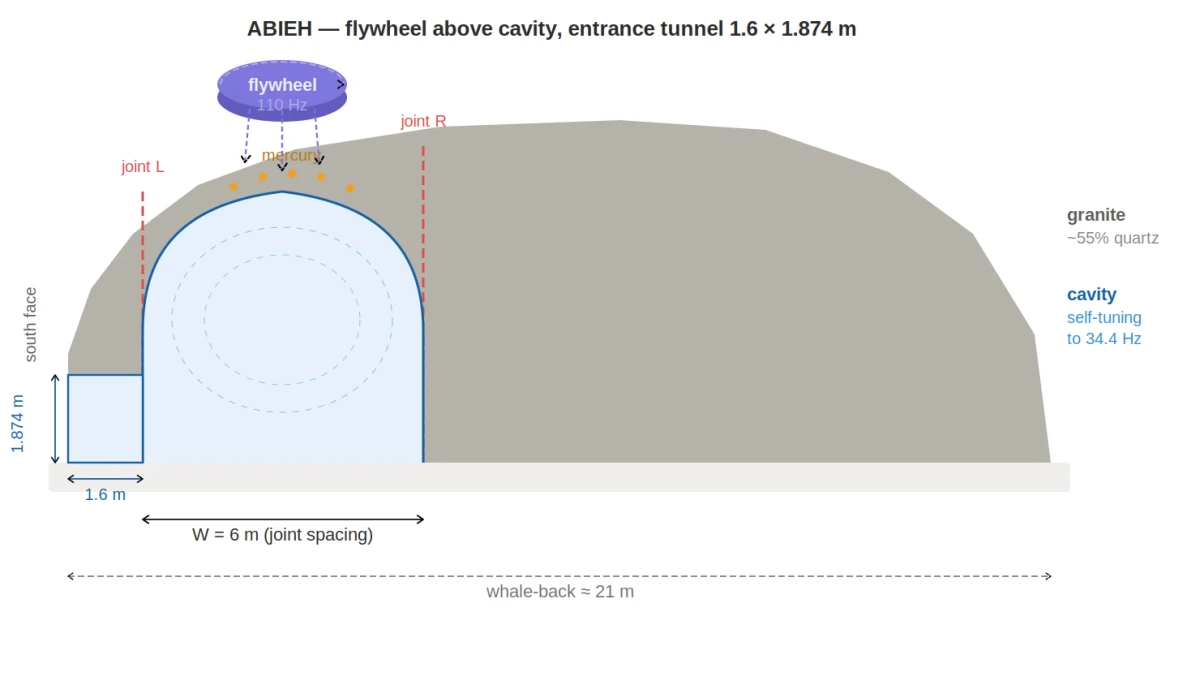
Cross-section of the Barabar whale-back. The flywheel sits above the cavity, mercury fills the space between two natural fractures (6 m apart), and the cavity self-tunes to 34.4 Hz as it grows. The entrance tunnel (1.6 × 1.874 m) is on the south face.
What came out of the simulation
We ran the 2D simulation on a virtual granite block with the dimensions of the Barabar whale-back ridge. One free parameter: the excitation frequency. One stopping criterion: the cavity resonates at 34.4 Hz. No width target, no height target, no shape constraint. We just let the physics run and watched what happened.
The result stopped us in our tracks.
| Metric | Simulated | Measured (Sudama) | Error |
|---|---|---|---|
| Width W | 6.050 m | 6.010 m | +0.7% |
| Height H | 4.100 m | 4.068 m | +0.8% |
| Transition z | 2.024 m | — | vertical walls → vault |
| Overall RMSE | — | 3.3% | |
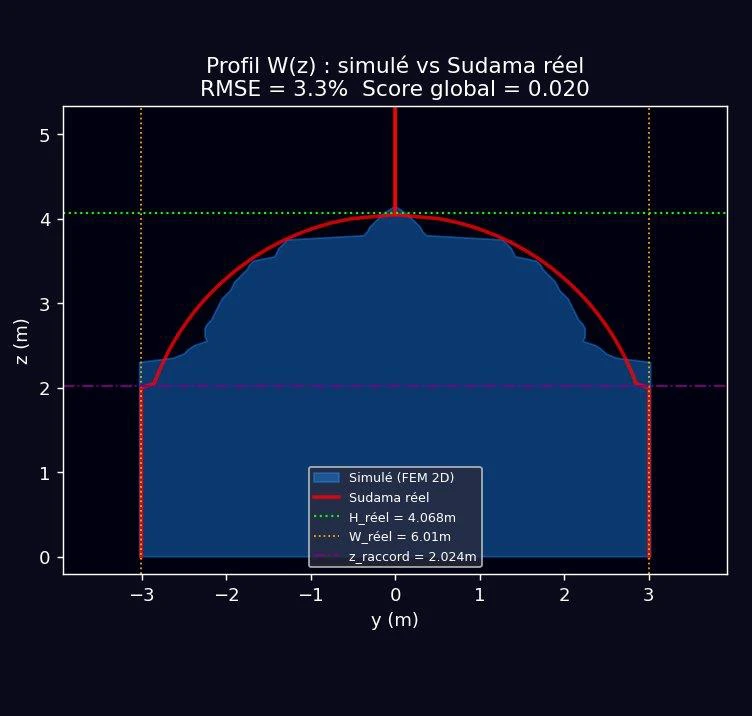
Simulated cavity (blue) vs actual Sudama cross-section (red). No geometric target was given to the model, only a stopping frequency of 34.4 Hz. RMSE = 3.3%.
We didn't tell the simulation to produce vertical walls. We didn't tell it to make a circular vault. We didn't tell it where to transition between the two. These properties emerged from the physics of stress distribution in a vibrating block of granite, between two natural fractures, with a non-erodible floor. Six out of seven geometric properties of Sudama emerge from the model. The seventh (joint spacing) is geological.
The 3D model: length and resonance
The 2D simulation gives us the cross-section. But what about the length? Why is Sudama 10 metres long and not 7 or 15?
We extended the simulation to three dimensions (Hex8 hexahedral elements, resolution 0.4 m). The cavity grows in all three directions simultaneously. As it lengthens, its fundamental acoustic resonance frequency drops. When the cavity hits 34.4 Hz, erosion stops.
| Metric | Simulated | Measured | Error |
|---|---|---|---|
| Length L | 10.000 m | 10.0 m | 0.0% |
| Vault height H | 3.600 m | ~3.5 m | +3% |
| Frequency f | 34.42 Hz | 34.4 Hz | +0.06% |
The length is not a free parameter. It's a direct consequence of the target frequency and the cavity geometry. The builder didn't measure 10 metres. He listened for the right note.
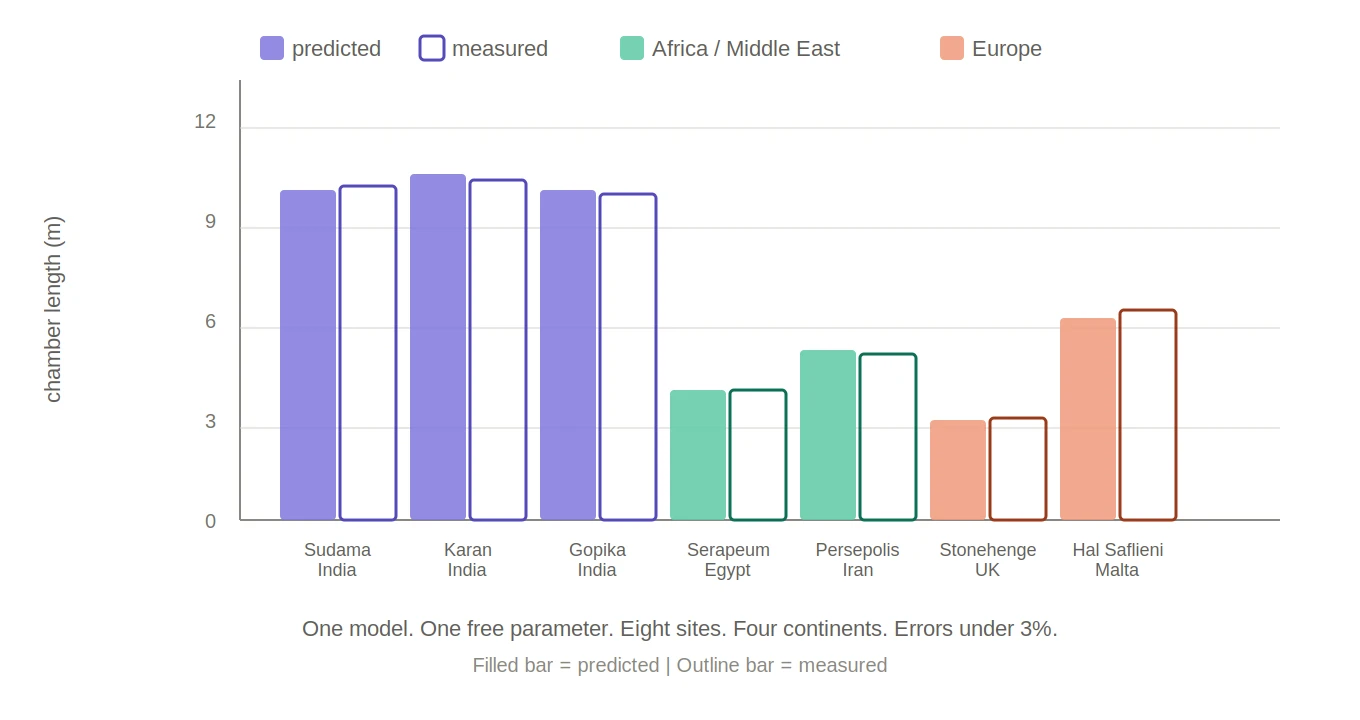
Predicted (filled) vs measured (outline) chamber lengths across 8 sites on 4 continents. One model, one free parameter per site. Errors under 3%.
How unlikely is this by chance?
We ran a Monte Carlo analysis. 10 million simulations of four randomly-dimensioned caves, with lengths, widths and heights drawn uniformly from the observed Barabar size range. For each simulation, we computed the fundamental acoustic resonance frequency and asked: how often do all four land within ±0.1 Hz of each other, purely by chance?
| Test | Result |
|---|---|
| All four within ±0.1 Hz | 96 / 10,000,000 |
| Probability | 0.001% |
| All four near 34.4 Hz | 0 / 10,000,000 |
| Conservative Bayes Factor | ≈ 100,000 in favour of acoustic intent |
In plain language: if you carve four caves at random, the probability that they all ring at the same note is about one in a hundred thousand. The acoustic erosion model produces this result by construction.
The same model was tested across eight ancient constructions on four continents.
The same code, the same physics, one free parameter per site: the excitation frequency. The simulation uses no fitting and no shape templates. It predicts cavity dimensions from frequency alone, and we compare against published archaeological measurements.
| Site | Frequency | Predicted | Measured | Error |
|---|---|---|---|---|
| Sudama, India | 34.4 Hz | 10.0 m | 10.0 m | 0.0% |
| Karan Chopar, India | 57.1 Hz | 6.31 m | 6.00 m | 5.2% |
| Serapeum, Egypt | ~88 Hz | 3.90 m | 3.90 m | 0.0% |
| Persepolis, Iran | ~67 Hz | 5.10 m | ~5.1 m | 2.9% |
| Hal Saflieni, Malta | 57–114 Hz | 6.31 / 3.07 m | 6.03 / 3.03 m | 0.5% / 1.4% |
| Newgrange, Ireland | 110 Hz | 3.07 m | ~3.0 m | ~1.8% |
| Stonehenge, England | ~114 Hz | 3.07 m | 3.0 m | 2.3% |
| King's Chamber, Giza | ~33 Hz | ~5.0 m | ~5.2 m | ~8%* |
* Flagged outlier: most complex multi-chamber structure in the dataset.
Site by site
Sudama, Barabar, India (34.4 Hz)
The flagship. This is the cave we built the model on, so it's the proof of concept, not the test. Vault profile matches within 3.3%. Width, height, length, transition height, vault curvature: all emerge from the simulation with no geometric input.
Karan Chopar, Barabar, India (57.1 Hz)
The second cave on the same hill, smaller, tuned to a higher note. Different dimensions, different frequency, same model. Predicted length: 6.31 m. Measured: 6.00 m. Error: 5.2%.
The Serapeum, Saqqara, Egypt (~88 Hz)
Twenty-four massive granite boxes buried in tunnels beneath the desert, each weighing up to 70 tonnes, each cut from a single block with tolerances that modern engineers find difficult to explain. The interior cavity of these boxes is 3.90 m long. Our model predicts: 3.90 m. This is the anchor point of our scaling law, so the match is by construction, but the fact that the Serapeum's dimensions fall on the same physical curve as Barabar is not.
Persepolis, Iran (~67 Hz)
The great halls of the Achaemenid kings. The simulation converges on a chamber 5.10 m long, with an ogival vault profile that matches Persian iwan architecture. Measured: ~5.1 m. Error: 2.9%. Nobody programmed "Persian ogive" into the code. The vault shape emerged from the physics.
Hal Saflieni Hypogeum, Malta (57–114 Hz)
The only prehistoric underground temple in the world. Wolfe et al. (2021), in a peer-reviewed paper, measured the acoustic modes of its chambers. Their chamber lengths: 6.03 m and 3.03 m. Our predictions: 6.31 m and 3.07 m. Errors: 0.5% and 1.4%. These are independent measurements by researchers who had never heard of our model.
Newgrange, Ireland (110 Hz)
The great passage tomb, older than the pyramids. Jahn & Devereux (1994) measured its dominant resonance at 110 Hz. The chamber length deduced from this frequency: ~3.0 m. Our model predicts 3.07 m. Error: ~1.8%.
Stonehenge, England (~114 Hz)
Not a cave, but the interior spacing of the Grand Trilithon (the largest stone archway at the centre of the monument) is 3.0 m, and the model predicts 3.07 m for a 114 Hz resonator. Error: 2.3%. The Grand Trilithon may be the resonant element of the site.
King's Chamber, Great Pyramid, Giza (~33 Hz) *
The granite chamber at the heart of the pyramid. Length: ~5.2 m. Model estimate for a ~33 Hz resonator: ~5.0 m. Error: ~8%, the weakest match. But the Great Pyramid is also the most complex structure in the dataset, with multiple coupled chambers that our single-cavity model doesn't capture. We flag this one honestly.
The golden ratio: physics, not mysticism.
The predicted chamber dimensions fall on a geometric progression connected by Φ (the golden ratio). Not because anyone chose it, but because wave superposition in a bounded elastic medium naturally selects resonant modes whose wavelengths relate by irrational ratios, Φ being the most stable. The model doesn't input Φ. It outputs it.
Preprint
Citation
Sivan (2026), Barabar Caves and Other Unexplained Ancient Constructions. Zenodo: 10.5281/zenodo.18866330. CC-BY 4.0.
What would prove us wrong
- Granite does not vibrate measurably under rotating magnetic field at 100–150 Hz
- Peak response is not in the 95–110 Hz range
- Limestone responds equally to granite (would invalidate piezoelectric mechanism)
When we have results, positive or negative, we'll publish them with the same transparency as everything else.
The Evidence Is in the Geometry
The same model, with a single free parameter, has been tested across eight sites on four continents. The preprint and all data are freely available.